
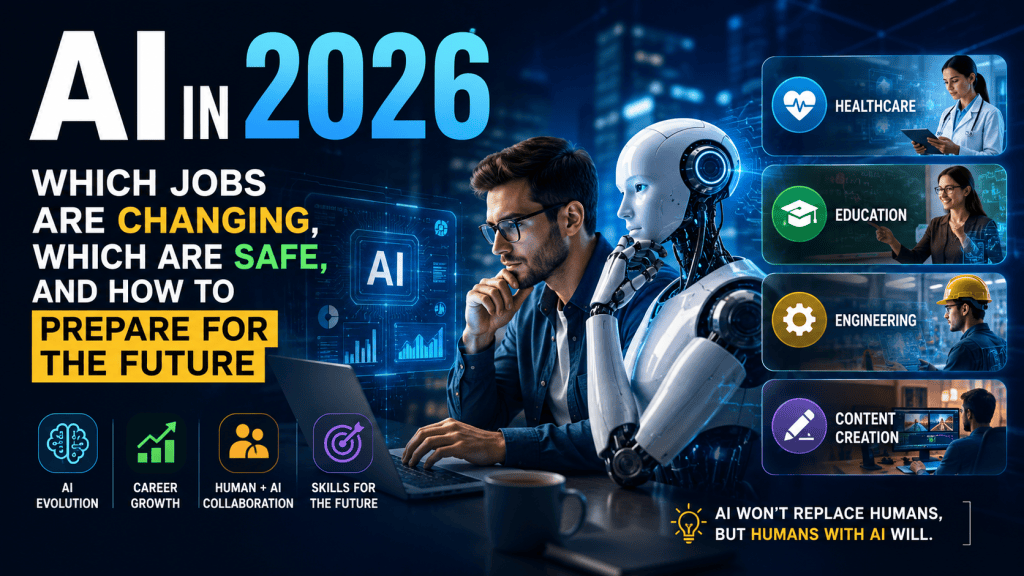
How Artificial Intelligence is reshaping careers, creating new opportunities, and helping professionals prepare for the future of work.
Artificial Intelligence (AI) has moved beyond science fiction and research laboratories. In 2026, it has become an essential part of everyday life, influencing the way people communicate, work, learn, shop, travel, and create content. From virtual assistants and automated customer service to medical diagnostics and software development, AI is transforming industries at an unprecedented pace.
As this transformation continues, one question dominates conversations worldwide:
Will AI replace human jobs?
The answer is more balanced than many headlines suggest. While AI is automating repetitive tasks and changing the nature of many occupations, it is also creating new opportunities, increasing productivity, and enabling people to focus on work that requires creativity, critical thinking, and human judgment.
Understanding these changes is essential for professionals, students, entrepreneurs, and businesses looking to succeed in the years ahead.
Why AI Is Growing So Quickly.
Several factors have accelerated AI adoption across industries.
Cloud computing has become more affordable, powerful AI models are now accessible to businesses of all sizes, and organizations are increasingly looking for ways to improve efficiency while reducing operational costs.
Businesses are also using AI to:
- Automate repetitive tasks
- Improve customer experiences
- Analyze large volumes of data
- Generate reports and content
- Enhance cybersecurity
- Support decision-making
Rather than replacing entire organizations, AI is becoming a valuable tool that supports human expertise.
Jobs Most Likely to Change.
Some professions involve repetitive and predictable tasks that AI can perform efficiently.
Examples include:
- Basic data entry
- Appointment scheduling
- Routine bookkeeping
- Standard customer support
- Simple content drafting
- Basic translation
- Administrative paperwork
This doesn’t necessarily mean these careers will disappear. Instead, professionals working in these areas are increasingly learning to supervise AI systems, verify outputs, and handle more complex responsibilities.
Careers That Continue to Grow.
Many careers depend on human creativity, empathy, ethical judgment, and interpersonal communication—qualities AI cannot fully replicate.
These include:
Healthcare.
Doctors, nurses, therapists, and healthcare specialists continue to provide patient care that requires compassion, experience, and informed decision-making.
Education.
Teachers and educators do far more than deliver information. They mentor students, encourage critical thinking, and adapt lessons to individual learning styles.
Skilled Trades.
Electricians, mechanics, plumbers, technicians, and construction professionals perform practical work in constantly changing environments where human expertise remains essential.
Creative Industries.
Designers, filmmakers, writers, photographers, artists, and musicians increasingly use AI as a creative assistant rather than a replacement.
Software Development.
AI can generate code and assist with debugging, but software engineers still design systems, solve complex challenges, and ensure quality and security.
New Careers Emerging in 2026.
AI has also created entirely new career opportunities.
Growing roles include:
- AI Trainer
- Prompt Engineer
- AI Content Editor
- AI Ethics Specialist
- Machine Learning Engineer
- Automation Consultant
- AI Product Manager
- AI Security Analyst
- Data Annotation Specialist
- Human-AI Collaboration Specialist
These professions demonstrate that technological progress often creates new jobs alongside changing existing ones.
Skills That Will Matter Most.
Success in the AI era depends on combining technical knowledge with uniquely human abilities.
The most valuable skills include:
- Critical thinking
- Creativity
- Problem solving
- Communication
- Leadership
- Adaptability
- Emotional intelligence
- Digital literacy
- Data analysis
- Continuous learning
People who embrace lifelong learning are more likely to adapt successfully to technological change.
How AI Benefits Individuals and Businesses.
Artificial Intelligence offers advantages for both professionals and organizations.
Businesses can improve efficiency by automating repetitive work, while individuals can use AI to save time, organize information, generate ideas, and increase productivity.
Content creators, marketers, educators, freelancers, and entrepreneurs are already using AI to:
- Brainstorm ideas
- Improve writing
- Create presentations
- Generate subtitles
- Produce marketing content
- Analyze customer feedback
- Plan social media campaigns
When used responsibly, AI acts as a productivity partner rather than a replacement for human expertise.
Common Misconceptions About AI.
AI Will Replace Everyone.
AI changes tasks more often than entire professions. Most careers will evolve instead of disappearing completely.
Only Technology Professionals Need AI.
People across healthcare, education, business, finance, agriculture, media, and government are increasingly using AI tools.
AI Is Too Difficult to Learn.
Many modern AI tools require no programming knowledge and are designed for beginners.
Practical Tips for Preparing for the Future.
If you want to remain competitive in the years ahead:
- Learn at least one AI tool.
- Strengthen communication skills.
- Continue learning throughout your career.
- Build a digital portfolio.
- Develop problem-solving abilities.
- Combine AI with your existing expertise.
- Stay informed about technological developments.
Small improvements made consistently often produce significant long-term benefits.
Final Thoughts.
Artificial Intelligence is transforming the workplace, but the future is not about humans competing against machines.
Instead, it is about humans using AI to become more productive, creative, and innovative.
Those who remain curious, continue learning, and embrace new technologies responsibly will be well-positioned for future opportunities.
The question is no longer whether AI will influence our lives.
The real question is:
How will you use AI to shape your future?
Frequently Asked Questions.
Will AI replace every job?
No. AI is expected to automate specific tasks while many professions continue to require human creativity, empathy, leadership, and decision-making.
Which careers are considered more resilient?
Healthcare, education, engineering, skilled trades, research, leadership, and creative industries are expected to remain important because they depend heavily on human expertise.
Should students start learning AI?
Yes. Understanding AI tools can improve productivity and prepare students for future workplaces across many industries.
Can small businesses benefit from AI?
Absolutely. AI can automate repetitive work, improve customer service, assist with marketing, and help businesses become more efficient.
Disclaimer
This article is provided for informational and educational purposes only. Technology and workplace trends evolve rapidly, and individual career or business decisions should be based on personal circumstances and additional research. Readers are encouraged to consult qualified professionals when making important career, financial, or business decisions.
 MindTrek Vlog