
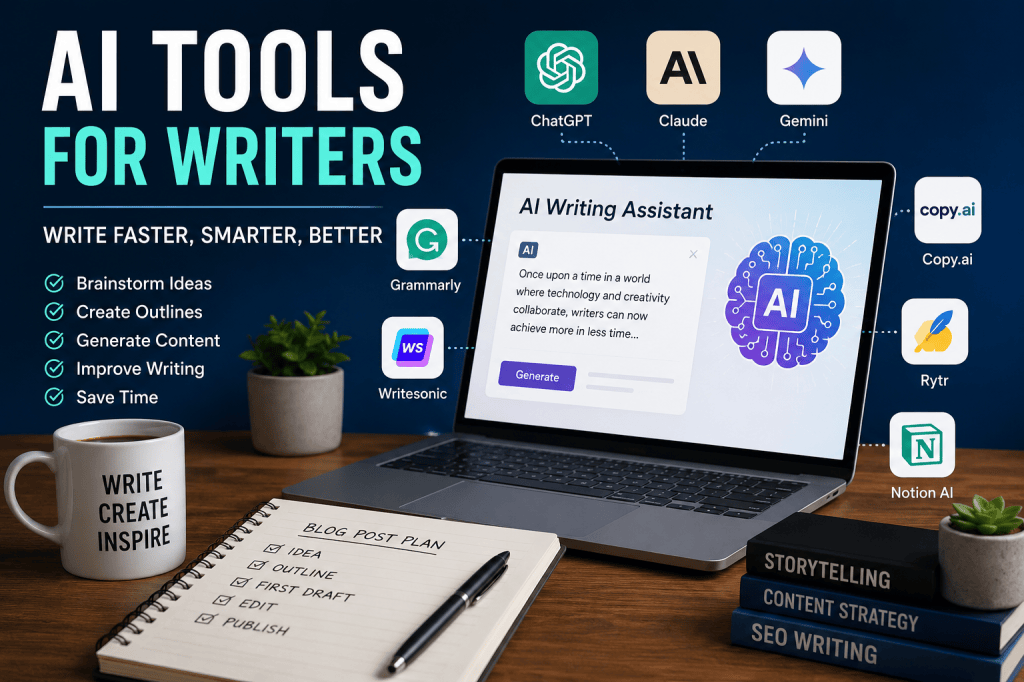
Artificial intelligence has transformed the way writers work. Whether you’re a blogger, novelist, freelancer, student, journalist, or content creator, AI tools can help you brainstorm ideas, improve grammar, generate outlines, optimize SEO, and even overcome writer’s block.
The key is understanding that AI is not here to replace writers—it is here to assist them. The best writing still comes from human creativity, experience, and judgment. AI simply helps you work more efficiently.
In this guide, we’ll explore the best AI writing tools available in 2026 and how each one can improve your writing workflow.
1. ChatGPT
One of the most versatile AI assistants available today, ChatGPT can help writers with:
- Brainstorming article ideas
- Writing outlines
- Drafting blog posts
- Editing and proofreading
- Creating social media content
- Research assistance
- Email writing
- SEO-friendly content
Best for:
- Bloggers
- Freelance writers
- Content creators
- Students
- Business owners
2. Claude
Claude is well known for handling long documents and maintaining a natural writing style.
It excels at:
- Editing lengthy articles
- Summarizing research
- Improving readability
- Maintaining consistent tone
- Reviewing manuscripts
Best for:
- Authors
- Researchers
- Technical writers
3. Google Gemini
Gemini integrates well with Google’s ecosystem, making it useful for writers who frequently use Google Docs, Gmail, and Drive.
Features include:
- Research assistance
- Writing support
- Brainstorming
- Fact organization
- Productivity improvements
4. Grammarly
Grammarly remains one of the most trusted writing assistants.
It helps with:
- Grammar correction
- Spelling
- Punctuation
- Tone detection
- Clarity improvements
Even experienced writers benefit from a final Grammarly check before publishing.
5. Jasper AI
Jasper specializes in marketing content.
Ideal for creating:
- Blog posts
- Landing pages
- Product descriptions
- Facebook ads
- Email campaigns
Businesses and marketers use Jasper to speed up content production.
6. Notion AI
If you organize your writing projects inside Notion, the built-in AI assistant can:
- Summarize notes
- Generate outlines
- Rewrite paragraphs
- Create meeting notes
- Organize research
7. Sudowrite
Sudowrite was built specifically for fiction writers.
It assists with:
- Character development
- Dialogue
- Story expansion
- Scene descriptions
- Creative brainstorming
Novelists often use it as a collaborative creative partner.
8. Hemingway Editor
Hemingway focuses on readability.
It identifies:
- Long sentences
- Passive voice
- Complex wording
- Difficult paragraphs
The goal is to make your writing easier to understand.
9. QuillBot
QuillBot is widely used for paraphrasing and rewriting.
Useful features include:
- Sentence rewriting
- Grammar checking
- Summarization
- Citation assistance
Always review AI-generated rewrites to ensure they accurately reflect your intended meaning.
10. Perplexity AI
Perplexity combines AI with web search.
It is useful for:
- Finding sources
- Research
- Fact checking
- Discovering references
This makes it valuable during the research phase of writing.
11. Canva Magic Write
Content creators who design graphics can also generate captions, presentations, and short articles directly within Canva.
Ideal for:
- Instagram captions
- Presentation text
- Marketing copy
- Visual storytelling
12. Rytr
Rytr offers a simple interface for creating:
- Blog ideas
- Product descriptions
- Emails
- Short-form content
It is beginner-friendly and affordable.
13. Copy.ai
Copy.ai focuses on business writing.
Popular use cases include:
- Sales emails
- Marketing copy
- Website content
- Product pages
14. Writesonic
Writesonic combines AI writing with SEO features.
It helps produce:
- Long-form articles
- Landing pages
- Product descriptions
- AI-assisted research
15. Frase
Frase is designed for SEO content writers.
It assists with:
- Keyword research
- Competitor analysis
- Content optimization
- Search intent analysis
Many bloggers use Frase to improve their chances of ranking on Google.
Can AI Replace Human Writers?
The short answer is no.
AI can generate words quickly, but it cannot fully replace human creativity, lived experiences, emotional understanding, critical thinking, or unique perspectives. The best results come from combining AI’s speed with human expertise.
Think of AI as a writing assistant—not the author.
Tips for Using AI Responsibly
- Always fact-check AI-generated information.
- Add your own experiences and opinions.
- Edit every draft before publishing.
- Avoid copying AI output without review.
- Maintain your unique writing style.
- Cite sources when appropriate.
- Follow the content policies of the platform where you publish.
Final Thoughts
AI has become an essential companion for modern writers. From generating ideas to polishing final drafts, these tools can save hours of work while improving productivity.
However, the most successful writers in 2026 are those who use AI wisely, not those who rely on it completely. Your creativity, voice, and personal insights remain your greatest strengths.
Experiment with different AI tools, discover the ones that fit your workflow, and use them to enhance your writing rather than replace it.
If used responsibly, AI can help every writer become more productive, more consistent, and more confident.
What AI writing tool do you use most often? Share your experience in the comments below!
 MindTrek Vlog