
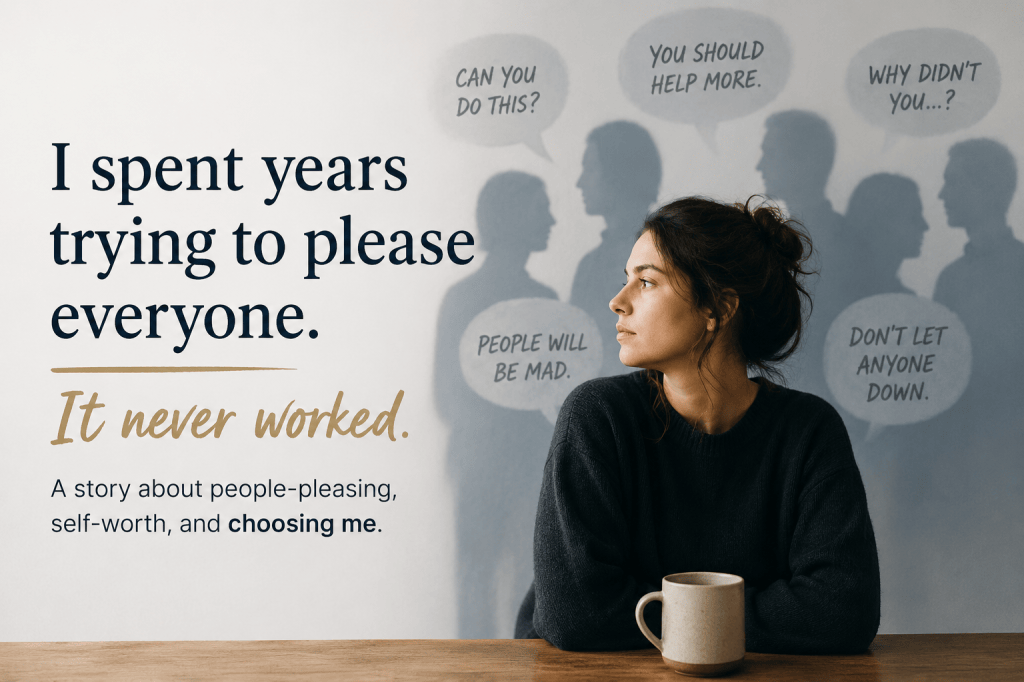
For most of my early years, I lived by an unspoken rule: say yes.
Yes to the extra task. Yes to the plan I didn’t want to be part of. Yes to opinions I didn’t agree with, just so I wouldn’t have to sit in the discomfort of someone being unhappy with me. I didn’t call it people-pleasing back then; I called it being agreeable, being easy to work with, and being nice. It felt like a virtue. It wasn’t. It was fear wearing a polite mask.
I think it came from inexperience more than anything else. When you don’t yet know your own worth, you borrow it from other people’s approval. Every “yes” felt like a small deposit into an account I thought I needed for acceptance, likability, and safety. I didn’t realize I was spending myself to fund it.
The cost showed up slowly.
It wasn’t one dramatic moment that broke the pattern. It was the quiet accumulation of exhaustion, agreeing to things I resented, showing up for people who wouldn’t have shown up for me, and losing track of what I actually wanted because I was so busy managing what everyone else wanted from me. Somewhere in there, I noticed a simple, uncomfortable truth: the people I was trying hardest to please rarely noticed the effort. And the ones who did notice didn’t respect me more for it. If anything, they asked for more.
Then it clicked: pleasing everyone isn’t a skill. It’s an impossibility.
You cannot make every person happy with your choices, your boundaries, your time, or your work. Someone will always want a different version of you. Trying to be that version for everyone doesn’t make you well-liked; it makes you inconsistent, stretched thin, and strangely invisible, because a person shaped entirely by other people’s expectations doesn’t have a shape of their own.
So I started saying no.
Not out of spite, not as a rebellion, just as a return to something more honest. No to obligations that drained me without purpose. No to opinions I didn’t hold, just to keep the peace. No to being available for everyone at the cost of being present for the people and things that actually mattered.
It didn’t feel good at first. Every “no” came with a flicker of guilt, a fear that I was becoming someone difficult, someone selfish. But over time, something shifted. The guilt faded, and in its place came something steadier: clarity. I started making decisions based on what I actually valued, not on what would keep the most people comfortable.
Now I live by my own principles, not the shifting expectations of a crowd.
That doesn’t mean I’ve become closed off or hard to work with. I still care about people, still show up, and still say yes often. But it’s a yes I choose, not one I default to out of fear. And when it’s a no, it’s not an act of rejection; it’s an act of self-respect.
If there’s one thing I’d tell my younger self, it’s this: you were never actually pleasing everyone. You were just quietly disappointing yourself to avoid disappointing others. Learning to say no didn’t make me less kind. It made me more honest with other people and with myself.


 MindTrek Vlog